Treatments & Diagnosis
Erectile Dysfunction & Penile Implants
ED diagnosis and treatment, from oral medication and injections to penile implant surgery, backed by the highest implant volume in Gujarat.
Treatments & Diagnosis for Erectile Dysfunction (ED) & Penile Implants
Erectile dysfunction (ED) is difficulty achieving or maintaining an erection firm enough for sexual activity. It's common, and it can affect men at any age, not just older men, though risk does increase with age.
As Gujarat's dedicated Andrology Hospital, EROS Hospital treats ED through the full range of options, from lifestyle changes and medication through to penile implant surgery, and is the leading centre in Saurashtra & Kutch for penile implant surgery, with the highest penile implant volume in the region.
How Common is Erectile Dysfunction?
A widely cited 2007 study from Johns Hopkins found that 18.4% of men aged 20 and older experienced ED, equivalent to over 18 million men in the US at the time. Rates were substantially higher among men with diabetes, at 51.3%, since diabetes affects the blood vessels and nerves involved in getting an erection.
What Causes Erectile Dysfunction?
- Lifestyle factors (smoking, excessive alcohol, obesity, lack of exercise)
- Diabetes
- Medications (blood pressure medication, antidepressants)
- Cardiovascular disease (high blood pressure, heart disease)
- Hormonal imbalances
- Prostate cancer treatment
- Surgical procedures (prostate, bladder, colon surgery)
- Spinal cord injuries
Treatment Options for Erectile Dysfunction
Diagnosis sometimes includes a penile Doppler scan with injection, used to assess blood flow into the penis when the cause isn't clear from history alone.
Whatever the underlying cause, there are treatment options that help most men, and if the first one you try doesn't work well, that doesn't mean nothing will. It's worth working through the options with your doctor rather than stopping after one attempt.
Lifestyle changes, regular exercise, a healthy diet, quitting smoking, and limiting alcohol, can meaningfully improve ED on their own or alongside other treatment.
Non-Surgical Treatments: Oral medications, penile injections, vacuum erection devices.
Surgical Treatment: Penile implants.
Non-Surgical Treatments for ED
Oral Medications:
Phosphodiesterase type 5 (PDE-5) inhibitors relax the muscles in the penis, improving blood flow enough to produce an erection. They work for around 70% of men with ED, regardless of age or background, but only with sexual stimulation, and their effect wears off after a few hours.
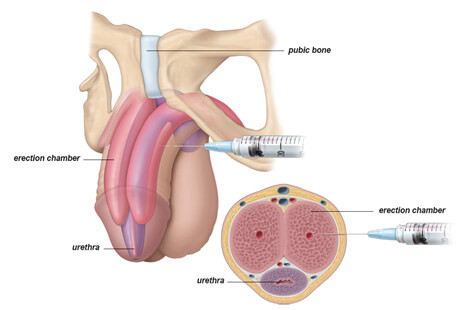
Penile Injections:
Alprostadil (a prostaglandin) is injected directly into the base or side of the penis to increase blood flow. Injections are generally limited to three times a week, and an erection typically develops within 5-20 minutes. It works for many men, but side effects like pain, needle anxiety, or fibrosis (scar tissue) at the injection site can occur, and roughly 60-65% of men stop using it within a year for these reasons.
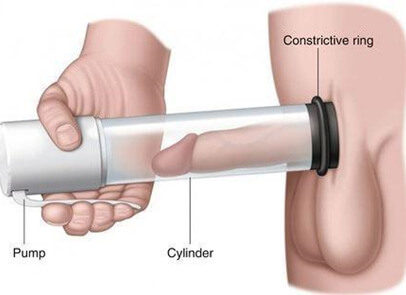
Vacuum Erection Devices (VED):
A drug-free mechanical pump that draws blood into the penis to create an erection. It's non-invasive and works for many men, though it can limit the sensation of ejaculation, making it better suited to some men than others.
Surgical Options: Penile Implants
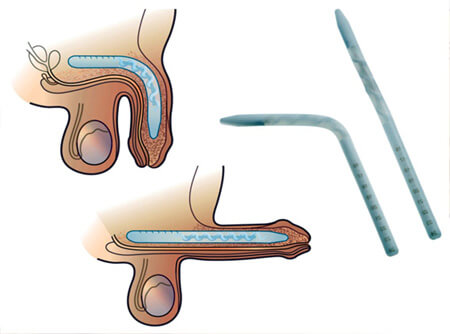
Malleable Implant
Penile Implants:
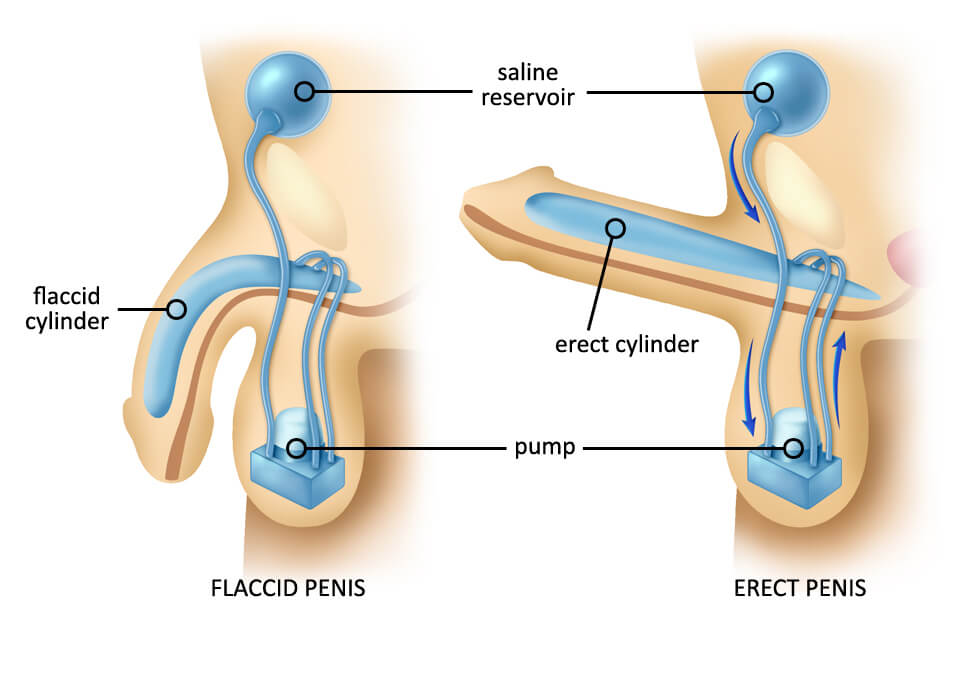
Penile implants, in use since 1971, are the main surgical option for ED and are entirely concealed within the body once placed. They're generally considered once other treatments haven't worked or aren't suitable. There are two main types: Malleable Implants, two bendable silicone cylinders that the man manually positions upwards to create an erection; and Inflatable Implants, cylinders connected to a pump and fluid reservoir hidden inside the body. Pressing the pump fills the cylinders to create an erection, and deflating it returns the penis to a flaccid state.
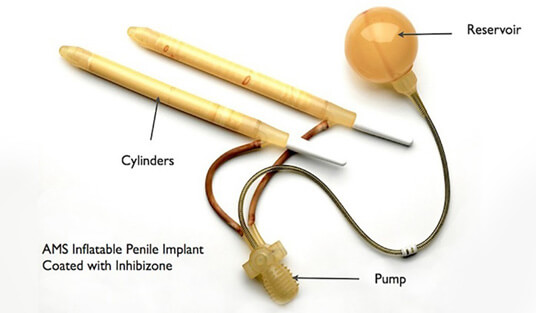
Inflatable Penile Implant
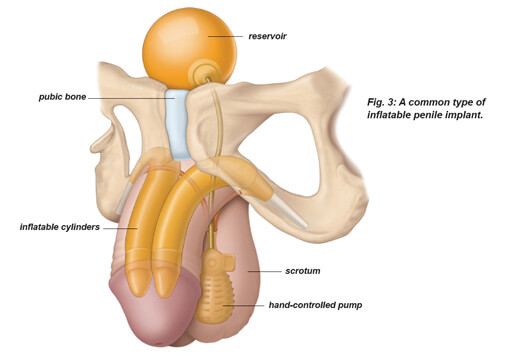
Inflatable Penile Implant in Anatomical Position
Key Features of Penile Implant Surgery:
- A permanent, durable solution for erectile dysfunction
- Minimal external scarring
- Completely concealed within the body
- Erections can be maintained for as long as desired
- Allows for spontaneous sexual activity, without waiting for medication to take effect
- Doesn't interfere with orgasm or ejaculation
- Reported satisfaction rates among patients and partners are generally high, based on published outcomes data
- Device failure is uncommon; inflatable implants typically last 10-15 years, with replacement possible if needed
Why Choose Us for Penile Implant Surgery?
Penile implant surgery works best with an experienced, dedicated andrology team, so we bring together urologists, andrologists, and support staff around each patient. Our hospital offers:
- Hospital in Saurashtra & Kutch for Penile Implant Surgery.
- Highest Penile Implant Volume in Gujarat.
- Dedicated Andrology Hospital in Gujarat.
- Surgical facilities equipped for penile prosthesis procedures and post-operative andrology care.
- Treatment plans built around each patient's specific health profile rather than a standard protocol.
- Structured post-operative monitoring to catch complications early.
- Discreet, confidential consultations and patient education for sensitive concerns.
We aim to keep patients and partners informed at each stage, since this is a personal decision that deserves clear, judgment-free information.
Penile Implant Procedure Steps
- Initial Consultation: A detailed evaluation by our andrology specialists, including diagnostic tests to confirm the cause of erectile dysfunction and rule out reversible causes.
- Treatment Discussion: A review of all available options, with implant surgery recommended only if other treatments haven't worked or aren't suitable.
- Surgery Preparation: Pre-operative assessment and instructions ahead of the procedure.
- Implant Surgery: The implant is surgically placed inside the penis, usually as a day-care or short-stay procedure.
- Post-Surgical Care: Close monitoring for infection or complications, followed by a structured recovery period before the implant is activated for use.
Each stage is handled with the patient's specific condition in mind, since outcomes depend heavily on how well the process is managed at every step, not just the surgery itself.
Meet Our Andrology Team
Our andrology team brings together urologists and support staff who coordinate closely with each other, so patients aren't left managing the sensitive parts of this process on their own.
We involve partners in the discussion where appropriate, since recovery and satisfaction usually depend on support at home as much as care at the hospital.